
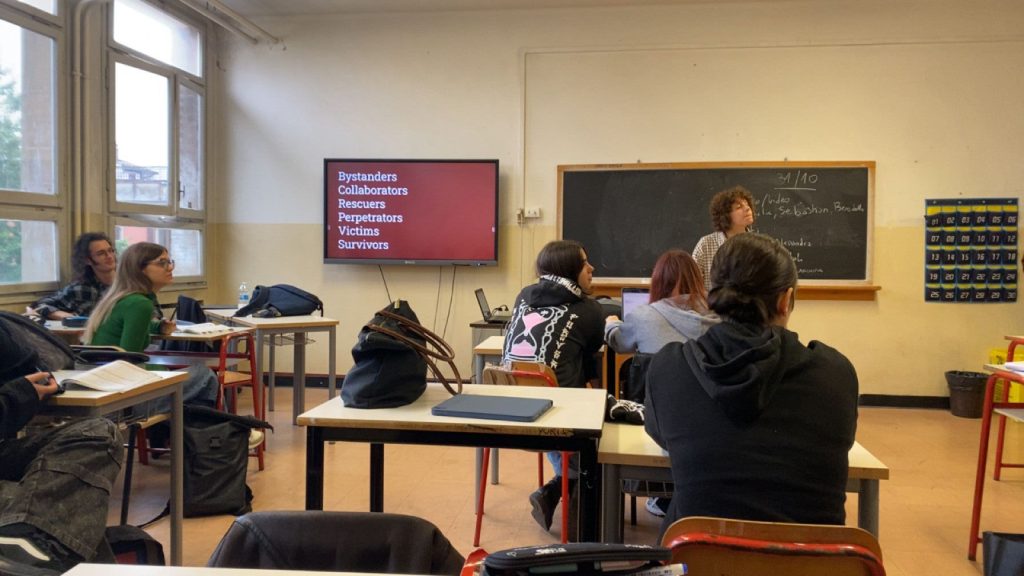
The fourth lesson of the project “Le Case di Micòl”, involving class 4C of the Luigi Einaudi Institute, began by reviewing the topics discussed in the previous session: perpetrators and victims, survivors, and the few living testimonies to which we still have access today. We reflected on the fact that no one maintained a fixed role throughout these events, highlighting the complexity of individual positions during the Holocaust.
We then returned to The Garden of the Finzi-Continis by Giorgio Bassani, summarising the plot of the novel and focusing on the importance of its time shifts. We observed that the novel mainly addresses the phase of discrimination and persecution during the Shoah, while the extermination itself appears only at the end, through the tragic fate of the Finzi-Contini family.
After that, we were assigned a task inspired by this reflection: to choose a book, a film, or a TV series focused on the Holocaust, analyse it, and present it to the class using the online board Padlet. Our virtual “wall” quickly filled with posters (and, in fact, far fewer book covers!). Among them were: Schindler’s List, A Bag of Marbles, Life Is Beautiful, The Boy in the Striped Pyjamas, The Book Thief, and The Pianist.
We began our analysis with Life Is Beautiful. All the students who had selected this film came to the board to explain why they chose it, what emotions it evoked, and which scenes they found most moving. It is certainly one of the works most closely associated with the extermination phase, even though this aspect is internally reversed and presented by the father to his son as if it were a game.
The next film we discussed was A Bag of Marbles, which deals with persecution and also makes space for the stories of the “Rescuers”, people who helped Jews escape and hide from persecution.
We then discussed The Boy in the Striped Pyjamas, a film widely appreciated for highlighting, through its two young protagonists, that children — unlike adults — do not have prejudice. However, we also reflected on its critical aspect: the emotional tension of the ending is built around empathy for the German child, leaving all the other — and far more real — victims of the extermination camps in the background.
When talking about escape attempts, we focused on The Pianist, Fanny’s Journey, and Schindler’s List, also recalling another well-known figure who organised the rescue of many Jews: Giorgio Perlasca, to whom one of our school workshops is dedicated.
Finally, we added a film that we had all watched together as a class: the animated film Where Is Anne Frank, in which Anne’s famous diary comes to life, telling her story in an authentic and deeply moving way.
Alessandra Valieri, Chiara Maria Sasso
Class 4C, IIS “Luigi Einaudi” – Ferrara, Italy